
Satya’s journey from adoption and attachment struggles to an identity rooted in faith
Long before Satya became Volunteer of RefugeRoot, she was a five-year-old girl leaving India to be adopted by a loving family in Sweden.
Her new family gave her a safe home, an education and genuine affection. They wanted her, welcomed her and cared for her.
From the outside, it could have looked like the perfect ending to a difficult beginning.
But love was there long before Satya knew how to feel safe within it.
When love is real, but trust is difficult
Early separation had already shaped Satya’s inner world. Entering a caring family changed her circumstances, but it did not instantly remove the fear that relationships could change or disappear.
This was not because her adoptive family failed to love her. It was not because Satya was ungrateful or unwilling to belong.
A child who has experienced loss may long for closeness while also protecting herself from it. She may receive affection but remain unsure that it will last. She may test relationships, withdraw from comfort or struggle to explain why being loved still feels frightening.
A child can be surrounded by love and still struggle to feel safe within it.
What attachment science tells us
Attachment is more than affection. It is the bond through which a child learns that a familiar caregiver will notice her signals, respond when she is distressed and remain emotionally available over time.
The World Health Organization’s Nurturing Care Framework recognizes responsive caregiving as a developmental need alongside health, nutrition, safety and early learning.
In other words, food, shelter and education are essential—but they do not replace a stable, emotionally responsive relationship.
Scientific research also helps explain why adoption can bring enormous healing without immediately resolving every attachment difficulty.
A meta-analysis of attachment in adopted children found substantial evidence of recovery: overall, adopted children could overcome early adversity and form secure attachments.
However, observational studies included in the review found that children adopted after their first birthday showed less attachment security on average than non-adopted children. Adopted children also showed more disorganized attachment than non-adopted peers, while doing better than children who remained in institutional care.
This is an important balance. Adoption can be deeply protective, but the age at placement and a child’s earlier experiences may influence how easily trust develops. These are findings about groups of children—not predictions about every adopted child.
Research on institutional care supports the same understanding.
A 2005 study from the Bucharest Early Intervention Project found serious attachment disturbances among young children raised in institutions. The researchers also found that the quality of caregiving was related to how attachment developed.
A 2025 systematic review similarly concluded that children in residential care can find it more difficult to establish secure attachment. It identified stable, skilled and supported caregivers as central to children’s emotional development.
Research also offers hope. In a randomized study, children moved from institutional care into stable family-based foster care were more likely to develop secure attachment, particularly when placement occurred earlier. A related trial found that some attachment-related signs decreased after placement in foster care.
These studies do not diagnose Satya or prove the cause of her personal experience. Much of the strongest intervention research was conducted in Romania—not India, Sweden, Togo or Benin. It provides credible scientific context, but Satya’s story remains her own.
A loving family cannot force the heart to feel safe
Satya’s adoptive family gave her love and stability. Those things mattered profoundly.
But attachment cannot be commanded, hurried or repaired through material security alone.
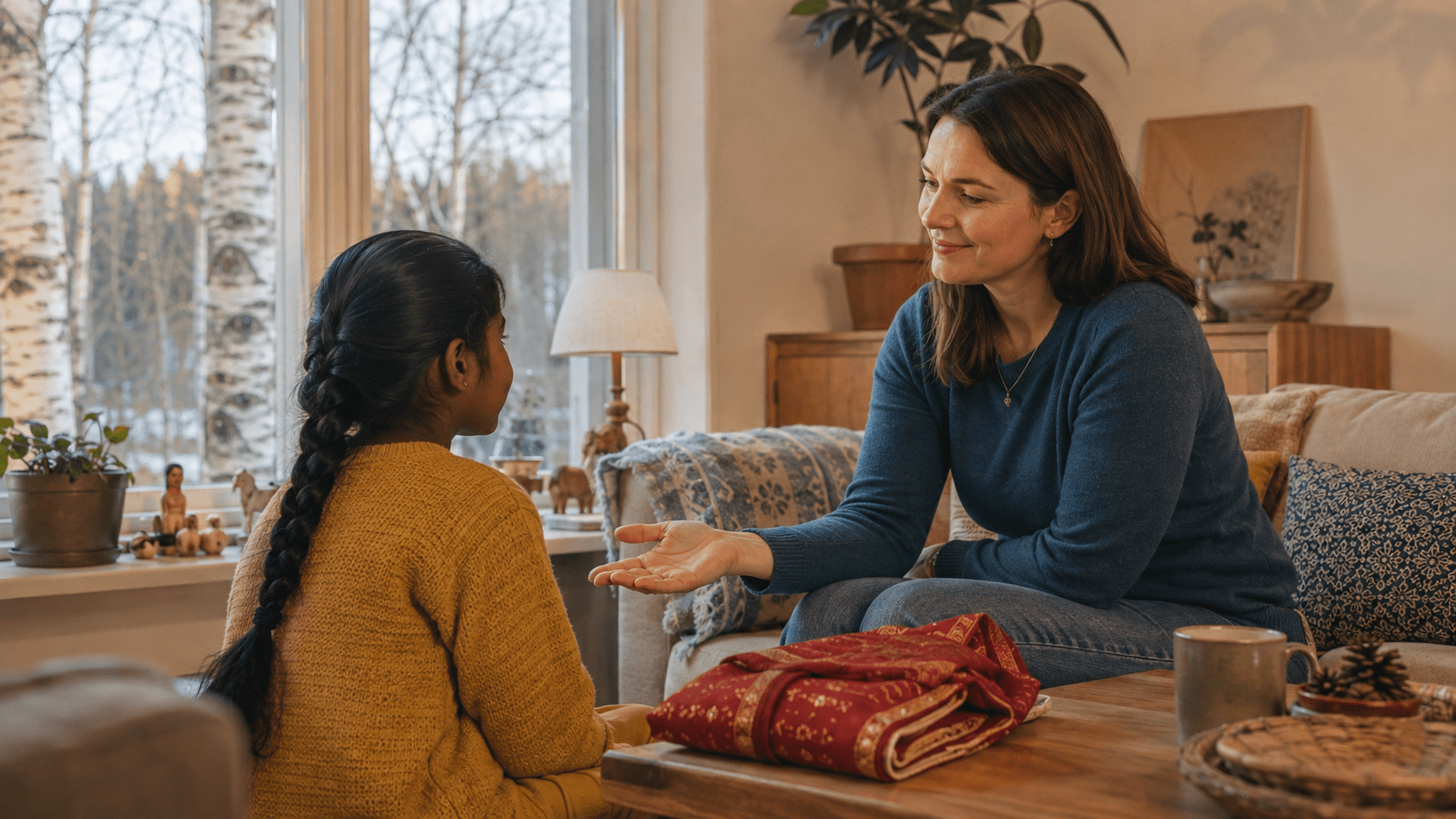
For some adopted children, trust grows slowly through years of predictable presence. Some may also need adoption-informed counselling, trauma-sensitive support and caregivers who understand that withdrawal or resistance can be a form of protection rather than rejection.
The struggle does not prove that the new family’s love is weak. It shows how deeply early relationships matter—and how patient later love may need to be.
The irreplaceable love that changed her identity
For Satya, the decisive turning point came through faith.
Through her relationship with God, she discovered a love that did not depend on her past, her birthplace, her performance or her ability to attach perfectly.
She began to feel seen, chosen and held by a love she experienced as irreplaceable.
Her faith did not erase her history. It gave her a way to embrace it.
She no longer had to choose between the little girl who left India and the daughter who grew up in Sweden. Both belonged to her story. Her identity could hold loss, adoption, family and faith without denying any part of her journey.
Faith is not a clinical treatment, and Satya’s experience is not a formula for every adopted child. For her, it became the personal anchor that helped love feel permanent and belonging feel possible.
Why Satya’s story shapes RefugeRoot
Today, as Volunteer of RefugeRoot, Satya carries this understanding into the organization’s work with vulnerable children.
Her journey reminds us that a bed, a meal, clean clothing and education are only part of what a child needs.
Children also need stable relationships, responsive care, emotional support and adults who remain patient when receiving affection is difficult.
It also reminds us that caregivers need support. Children’s homes cannot respond fully to attachment difficulties through goodwill alone when caregivers are overextended, frequently changing or unequipped to recognize the effects of early separation.
Caregivers need training, continuity, appropriate working conditions and access to psychosocial support.
At RefugeRoot, we do not want to see a vulnerable child as a list of needs to meet. We see a life that deserves to be accompanied with patience, dignity and love.
No child should merely have a place to live. Every child deserves to feel safe enough to belong.
Help Children Feel Safe Enough to Belong